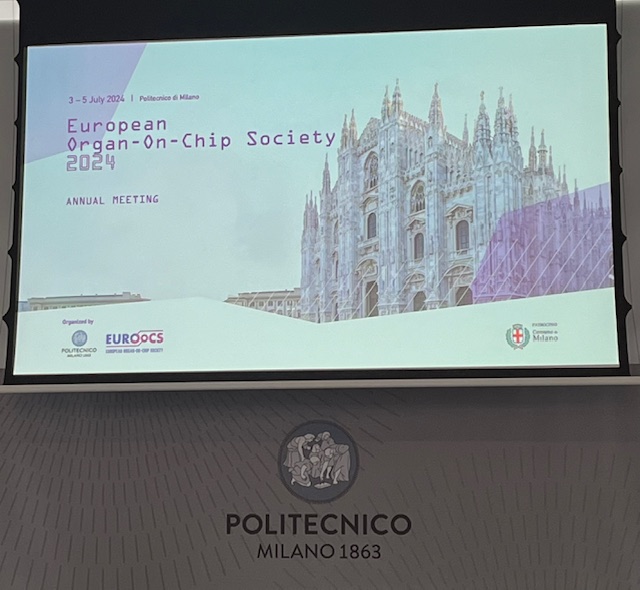
The BIRDIE team has had an exciting summer of science with our researcher attending multiple conferences and meetings, including participation at TERMIS in Seattle and at the EUROoCS in Milan. Going to meetings is a great way for us to share our ongoing progress and connect with the research community. We can now return to our labs with our heads filled with fresh ideas and heaps of inspiration to take the BIRDIE project forward. We connected with Coraline Chéneau from Nantes Univesité to get impressions on her attendance to the EUROoCS meeting in July this summer.
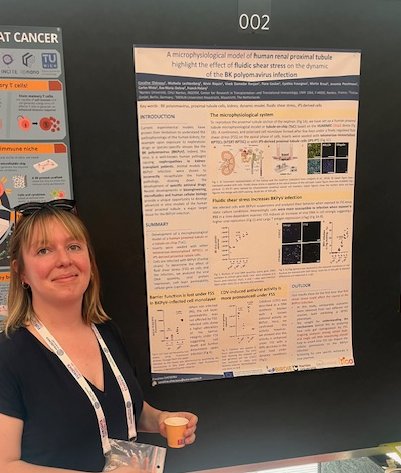
Can you tell us about the work that you presented at the EUROoCS meeting?
We presented a poster showing how fluidic shear stress impact BK virus infection in proximal tubule cells. We have cultivated the proximal tubule cells under dynamic condition by placing them into the HUMIMIC Chip2 from TissUse. There, we observed that under dynamic condition, BKV infection is increase. We also found that antiviral have higher effect on impairing viral replication under the same conditions.
What are your most important findings and what are the broader implications of your research?
There are just a few studies that have looked at viral infection using dynamic models and the most important findings are yet to come. By investigating which cellular mechanisms that are responsible for the increased infection rate that we see under dynamic conditions, we are step by step building a better understanding of BK virus infection, which is an important cause for kidney disease.
What do you personally find most exciting about the work that you do?
Overall, developing a new proximal tubule model is really exciting. For me though, the major challenge and what is driving me in terms of having an impact on biological research, is using the models to obtain better understanding the infection process that drive the enhanced infection.
What did you enjoy most at this year’s EUROoCS meeting?
It had a great time meeting with the organ-on-chip community and seeing how the devices used have evolved since the MPS world summit that took place in Berlin last year. It was also very valuable to see how other research groups are looking at viral and microbial infection across a range of different devices such as pulmonary and mucosal models. We advance significantly our own research by learning with others’ model infection and adapting the insights to our specific conditions.
 BIRDIE Project Website