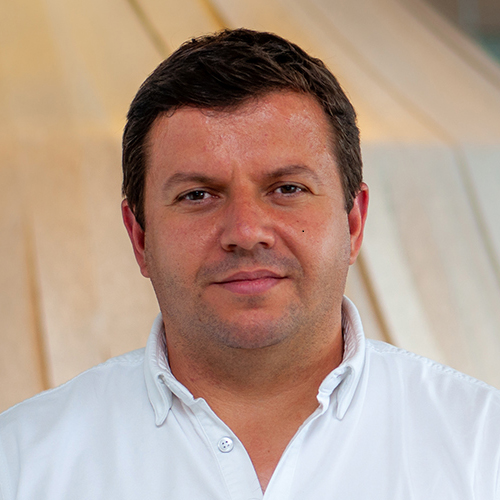
Dr. Carlos Mota
Assistant Professor in the Department of Complex Tissue Regeneration, MERLN Institute for Technology-inspired Regenerative Medicine, Maastricht University
Can you tell us about who you are and what your role in BIRDIE is?
My name is Carlos Mota. I am an engineer by training with a PhD in biomaterials. I am the BIRDIE project coordinator and WP2 and WP6 leader. The WP2 is focused on the establishment of differentiation of renal progenitors derived from human induced pluripotent stem cells (hiPSCs) and the team of the University of Maastricht (the Netherlands), is also focusing on the development of hydrogel biomaterial for bioprinting and on-chip tubulointerstitium models. WP6 is focused on the management activities and interface with the European commission.
What is the focus of the research that you are leading?
My team is establishing differentiation protocols to generate renal cell progenitors from hiPSCs. Furthermore, we are also developing hydrogel biomaterial inks for bioprinting. The cells and biomaterials will be combined and bioprinted to achieve the aimed humanized kidney tubulointerstitium model.
What is your team working on right now?
We are currently refining both cell protocols and biomaterials to achieve a physiologically relevant response of cells after bioprinting. We aim to integrate the bioprinting constructs in an organ on chip model in the next phases of the project.
Read more about BIRDIE’s contribution to kidney health
BIRDIE recognized by European Commission Innovation Radar
A key objective for the BIRDIE project has been to bring together expertise from different research areas to create innovative technologies that extend what is possible within kidney research and disease modeling. Because of this, we are proud to announce that several of the techniques and platforms developed through the project have been recognized by…
 BIRDIE Project Website